

The Autumn Hearth: Chestnuts & the Lost American Harvest

There is something wonderfully old-fashioned about a bag of fresh chestnuts.
They arrive with their smooth mahogany shells still shining, heavy in the hand and looking almost too beautiful to cut into. For many of us today, chestnuts are something we know more from a Christmas song than from our kitchens. We picture them roasting over an open fire, perhaps, but few of us actually bring them home and roast them.
There was a time when that would have been difficult to imagine.
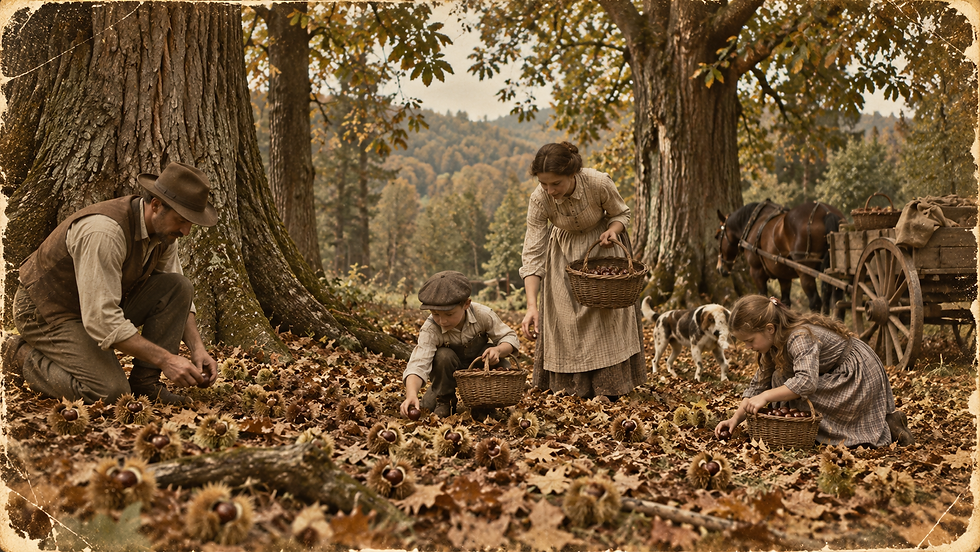
Across Europe, families gathered them from forests and orchards as a valuable seasonal food which fed communities for centuries. When European settlers crossed the Atlantic, they brought those culinary traditions with them—and encountered vast forests filled with another species, the native American chestnut.
For early Americans, chestnuts could be gathered rather than planted, eaten fresh or preserved, fed to livestock, sold for extra income, and incorporated into familiar dishes brought from the Old World.
And then, within the span of only a few decades, one of America's great food trees nearly disappeared.
The story of the American chestnut is therefore more than the story of an ingredient. It is a story about forests and families, abundance and loss—and about how quickly an ordinary food can vanish from everyday life. Its story also belongs naturally beside the apples, grains, squash, game, and other foods of the Autumn Hearth—not simply because chestnuts were once common, but because they show how European food traditions adapted to the abundance of a new landscape.
But chestnuts themselves have not disappeared.
Fresh chestnuts are still grown in America, and every autumn there is a brief window when growers begin sending out the new harvest. They may require a little more effort than opening a bag of walnuts or pecans, but perhaps that is part of their charm. You score the shell, apply heat, peel them while they're still warm, and suddenly this glossy brown nut becomes something soft, fragrant, sweet, and remarkably versatile.
This autumn, I want to bring chestnuts back to the hearth.
The Chestnut Before America

Long before Europeans settled North America, the European chestnut (Castanea sativa) was an important food across parts of Italy, France, Spain, Portugal, and other regions of Europe.
This was especially true in mountainous areas where growing wheat could be difficult. Chestnut groves could produce substantial amounts of carbohydrate from steep land poorly suited to fields of grain. In some regions, the chestnut became known as the “bread tree.”
Chestnuts were eaten fresh, roasted, boiled, dried, and ground into flour. Communities even developed specialized drying houses where the autumn harvest could be slowly preserved before milling.
Chestnut flour became porridge, breads, pancakes, cakes, pasta, and other regional foods. In Italy, it became the basis for rustic dishes such as castagnaccio, a dense, rustic cake traditionally made without the quantities of refined sugar we expect in modern desserts.. In France and elsewhere, chestnuts appeared in soups, purées, stuffings, breads, and eventually elaborate sweets.
The chestnut wasn't merely a treat. It could be a staple.
Those traditions mattered when Europeans began settling across the Atlantic.
A Familiar Food in a New Forest

European settlers arrived in North America carrying more than seeds and livestock. They also carried generations of culinary knowledge—ways of baking, preserving, roasting, brewing, and making use of the plants and animals around them.
In the eastern forests they encountered the American chestnut (Castanea dentata).
And it was everywhere.
It is difficult to understand the story of the American chestnut without first understanding just how enormous its presence once was.
Before the twentieth century, the American chestnut (Castanea dentata) was one of the dominant hardwood trees of the eastern United States. Its range stretched from parts of the South into New England and westward into the Appalachian region. In some areas of the Appalachians, chestnuts made up a remarkable portion of the forest.
These were not small trees hidden among the oaks.
Mature American chestnuts could grow more than 100 feet tall, with massive trunks and broad crowns rising into the forest canopy. Old photographs show people standing beside chestnut trunks several feet across—visual reminders of just how imposing these trees could become.
And every autumn, they produced food.
Unlike oaks, which can have irregular acorn crops, chestnuts were valued for producing dependable annual harvests. Their burr-covered fruits ripened in autumn, splitting open to reveal the glossy brown nuts inside. Wildlife descended upon them, livestock could be turned into wooded areas to forage beneath the trees, and families gathered chestnuts for their own tables or for sale.
The tree itself was equally valuable. American chestnut wood was straight-grained, lightweight, easy to work, and naturally resistant to decay. It became everything from fence posts and railroad ties to barns, furniture, shingles, telephone poles, and the timbers of homes.
The chestnut was therefore woven into everyday life in a way that is difficult for us to imagine now.
It provided food overhead, forage underfoot, timber for buildings and fences, and—in rural communities—a crop that could provide additional income. A chestnut tree did not need to be replanted every spring or cultivated like a field of grain. Once established, it could continue producing food for generations.
Then the trees began to die.
When the Chestnut Forests Disappeared

Around the beginning of the twentieth century, an introduced fungal pathogen responsible for what became known as chestnut blight appeared in the United States. The disease entered wounds in the bark and formed cankers that eventually girdled branches and trunks, cutting off the flow of nutrients and water.
The American chestnut had little natural resistance.
The blight spread with devastating speed through eastern forests. Trees that had stood for generations began dying above ground, and within only a few decades the great chestnut forests had been transformed.
The species was not technically driven to extinction. American chestnuts can still sprout from surviving root systems because the fungus generally attacks the tree above the soil line. In forests where towering chestnuts once stood, small shoots may still emerge from roots that have persisted underground. Many eventually succumb to the blight before they can mature and reproduce as the enormous trees their ancestors once became.
That makes the American chestnut an unusual kind of ghost in its own forest.
It is still here.
But the ecosystem—and the human food culture—that once surrounded it is largely gone.
Today, researchers, growers, conservation organizations, and breeders continue working toward restoring the American chestnut, including efforts to develop trees with greater resistance to the blight. At the same time, American orchards grow other chestnut species and hybrids capable of producing the fresh chestnuts we can still bring into our kitchens each autumn.
When we roast chestnuts today, then, we are participating in something much older than a Christmas tradition.
We are tasting a small reminder of a harvest that once fell by the millions beneath American trees.
Chestnuts Aren’t Really Like Other Nuts

Pick up a walnut, pecan, or hazelnut and you are holding a food concentrated in fat and calories. Pick up a chestnut and you are holding something quite different.
Chestnuts may grow inside a burr and wear a hard brown shell, but nutritionally and culinarily they behave almost as though a nut and a starchy vegetable decided to meet somewhere in the middle.
Their most striking difference is their high carbohydrate and relatively low fat content. While most tree nuts derive much of their richness from natural oils, chestnuts contain considerably less fat and much more starch.
That difference becomes obvious as soon as they are cooked.
A roasted walnut remains crunchy and oily. A roasted chestnut becomes soft, floury, and almost creamy. Its texture can be reminiscent of a small roasted potato, although its flavor is sweeter, nuttier, and more aromatic.
That is exactly what makes chestnuts so versatile.
They can provide body to soups and stews, be mashed into purées, folded into stuffings, paired with grains, incorporated into breads and cakes, or ground into flour. Their gentle sweetness works with apples, pears, honey, vanilla, and chocolate, while their earthy side is equally comfortable beside mushrooms, sage, rosemary, thyme, onions, winter squash, beans, and roasted meats.
Chestnuts also have another unusual characteristic for a nut: fresh chestnuts contain vitamin C. Some of that vitamin is lost with storage and cooking, particularly with prolonged heat, but its presence further distinguishes the chestnut from many of the nuts we commonly keep in the pantry.
They also provide fiber and minerals, along with their carbohydrate content, which helps explain why chestnuts could historically serve as something much more substantial than a garnish or snack.
Buying & Storing Fresh Chestnuts
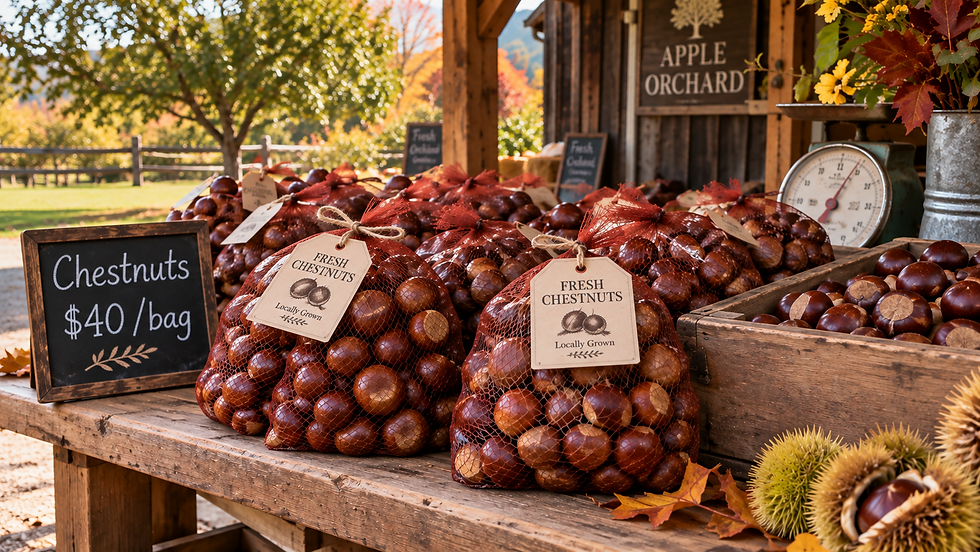
If you are accustomed to buying walnuts, pecans, or almonds, fresh chestnuts require a small change in thinking.
They are a seasonal, perishable crop.
The best chestnuts begin with freshness, and when possible, autumn is the time to seek them out. Chestnut harvest in the United States generally begins in early fall and continues through the autumn months, depending on the variety, growing region, and weather.
Buying directly from a chestnut orchard or grower can be particularly worthwhile during harvest season. Instead of chestnuts that may have spent an unknown amount of time moving through storage and distribution, you may be able to purchase nuts much closer to the time they were harvested.
What to Look For
Fresh chestnuts should feel firm, plump, and surprisingly heavy for their size.
Look for smooth, glossy shells without obvious cracks, holes, or signs of mold. The shell should fit tightly around the nut rather than feeling loose or hollow.
Give one a gentle shake.
Ideally, you shouldn't hear much movement inside. A chestnut that rattles has often lost moisture, causing the kernel to shrink away from its shell. It isn't necessarily spoiled, but it is no longer at its freshest.
Very lightweight chestnuts are another indication that the nut inside may have dried considerably.
Small holes in the shell can indicate insect damage, while visible mold, an unpleasant odor, or a shell that feels unusually soft are reasons to discard the nut.
Unfortunately, chestnuts occasionally hide their problems well.
A perfectly respectable-looking shell can conceal a nut that is moldy, discolored, shriveled, or otherwise deteriorated inside. When peeling chestnuts, take a moment to look at each kernel rather than automatically adding everything to your recipe.
A healthy chestnut should have firm flesh and a pleasantly sweet, nutty aroma. If something smells sour, fermented, musty, or simply wrong, don't use it.
Don't Store Them in the Pantry
Perhaps the biggest mistake a first-time chestnut buyer can make is placing a beautiful bowl of them on the kitchen counter and treating them like decorative walnuts.
Fresh chestnuts contain a great deal of moisture.
That moisture gives them their wonderful texture when cooked, but it also makes them much more perishable than most nuts. Left at room temperature for extended periods, they can dry out or spoil.
Keep fresh chestnuts refrigerated.
They need cold storage while still allowing some protection from excess condensation and moisture. If your chestnuts came directly from a grower, follow the grower's storage instructions when provided, since handling and curing practices can differ.
Check the nuts periodically as well. One moldy chestnut tucked among otherwise healthy ones is best discovered before it has the opportunity to affect its neighbors.
If you know you won't use your chestnuts while they're still fresh, freezing is another excellent option. They can be frozen for longer storage, either raw or after cooking and peeling, depending upon how you expect to use them later.
Personally, I find cooked and peeled chestnuts especially convenient to freeze. Once the messy work has already been done, a portion can be pulled from the freezer and added to soup, stuffing, vegetables, baked goods, or other dishes without starting the peeling process all over again.
Chestnut Season Is Brief—and That's Part of the Pleasure
We have become accustomed to walking into a grocery store and expecting almost every ingredient to be available every month of the year.
Fresh chestnuts are a reminder that food once had a much more obvious season.
The burrs open.
The nuts fall.
The harvest arrives.
And then it is gone.
There is something satisfying about allowing an ingredient to retain that sense of occasion. Instead of expecting fresh chestnuts in April, we can enjoy them abundantly for a few autumn weeks, preserve some for winter, and then wait for the trees to produce another crop.
That rhythm makes the first chestnuts of autumn feel like what they once were:
a harvest worth noticing.
How to Roast, Boil & Peel Fresh Chestnuts
Fresh chestnuts have one small barrier standing between you and everything you might want to make with them:
The peel.
Actually, two peels.
Beneath the glossy brown outer shell is a thin, papery inner skin called the pellicle, which clings tightly to the chestnut. Removing both can be frustrating if you approach chestnuts like other nuts, but once you understand how heat and moisture loosen those layers, the process becomes much easier.
The most important rule is simple:
Peel chestnuts while they are still warm.
As chestnuts cool, that inner skin begins tightening against the flesh again. Trying to peel an entire cold batch is one of the quickest ways to decide that cooking fresh chestnuts isn't worth the trouble.
It is.
You just need to work in batches.
First, Always Score the Shell

Whether you plan to roast, boil, or steam your chestnuts, begin by scoring each one.
Chestnuts contain considerable moisture, and heating them inside an intact shell can cause pressure to build. Cutting through the shell allows steam to escape and, just as importantly, gives you a place to begin peeling afterward.
Using a small, sharp paring knife or a chestnut knife, place each chestnut securely on a cutting board and carefully cut an X through the shell on the rounded side. Cut through the outer shell and into the inner skin without slicing deeply into the chestnut itself.
Some cooks prefer making one long slit across the rounded side instead. Either method works; the goal is to open the shell enough that it can pull away as the chestnut cooks.
Method One: Roasting

If your first thought when you hear the word chestnut is roasting, there is good reason for it.
Roasting intensifies their natural sweetness and gives chestnuts a wonderfully warm, nutty aroma. It is my preferred method when the chestnuts themselves will be eaten as a snack or when I want that roasted flavor to contribute to the finished dish.
Heat the oven to 400°F.
Arrange the scored chestnuts in a single layer on a baking sheet, with the scored side facing upward. Roast for approximately 20–30 minutes, depending on their size.
They are ready when the shells have begun curling back around the cuts and the chestnut inside is tender.
Now comes the important part.
Don't dump the entire tray onto the counter and allow it to cool.
Wrap the roasted chestnuts in a clean kitchen towel, or place them in a covered bowl, so they remain warm and slightly steamy. Remove only a few at a time and peel away both the hard shell and the papery inner skin.
If the last chestnuts become difficult to peel because they've cooled, warm them briefly again.
Method Two: Boiling

Roasting may have the romance, but boiling has its own advantages.
If the chestnuts are destined for soup, purée, stuffing, sauce, or another recipe where roasted flavor isn't necessary, boiling provides tender chestnuts while maintaining plenty of moisture.
Place the scored chestnuts in a saucepan and cover them generously with water. Bring the water to a boil, reduce to a steady simmer, and cook until the chestnuts are tender, generally around 15–25 minutes, depending upon size.
Instead of draining the entire pot, leave the remaining chestnuts sitting in the hot water.
Remove a few with a slotted spoon and peel them while they are still warm. Then retrieve another small batch.
The hot water helps keep both the shell and pellicle pliable while you work.
Method Three: Steam Them

Steaming provides something of a middle ground.
Score the chestnuts, place them in a steamer basket over simmering water, cover, and steam until tender. Depending upon their size, this will generally take around 20–30 minutes.
Again, keep the remaining chestnuts covered and warm while peeling a few at a time.
Steamed chestnuts retain moisture well and have a clean flavor, making them particularly useful when they will become purées, soups, fillings, or other preparations where you want the flavors added later to take center stage.
What About That Stubborn Inner Skin?
Even when you've done everything correctly, occasionally a chestnut simply refuses to cooperate.
The outer shell comes away beautifully and there it is—the fuzzy brown pellicle stubbornly embedded in every little groove.
Don't fight a cold chestnut.
Return stubborn chestnuts to the hot water, steamer, or oven for a few minutes and try again. Heat and moisture are your allies.
And don't worry if every chestnut doesn't emerge perfectly whole.
Beautiful whole chestnuts are useful when appearance matters, but broken pieces taste exactly the same. If they're headed for soup, stuffing, bread, purée, porridge, or flour, no one will ever know that they came out of their shells in three pieces.
Set the prettiest whole chestnuts aside for dishes where they'll be visible and use the broken ones everywhere else.
Roast or Boil?
Neither method is inherently better. Think about what you want the chestnut to contribute to your recipe.
Roast when you want deeper, sweeter, toastier chestnut flavor.
Boil or steam when you want softer, moist chestnuts with a more neutral flavor that can absorb the flavors surrounding them.
Once the shells are gone, fresh chestnuts suddenly stop looking like a difficult specialty ingredient.
They become simply another food waiting to be cooked.
Mash them with herbs. Stir them into soup. Pair them with mushrooms. Fold them into stuffing. Simmer them with beans. Bake with them. Purée them into something creamy.
Or eat one while it's still warm.
You may understand why generations of people looked forward to chestnut season.
Preserving the Chestnut Harvest
A generous chestnut harvest presents the same question that accompanies so many seasonal foods:
How do we keep some of it for later?
For generations of people who depended upon chestnuts, preservation wasn't simply a way to avoid waste. It transformed a relatively short autumn harvest into food that could nourish a household well into winter and beyond.
Today, we have the advantage of refrigerators and freezers, but some of those older methods—particularly drying and grinding chestnuts into flour—are still remarkably useful.
Freeze Them for the Easiest Preservation

For most modern kitchens, freezing is probably the simplest way to preserve chestnuts.
Cook and peel the chestnuts, allow them to cool completely, and divide them into portions based on how you are likely to use them. Freeze them in airtight freezer containers or bags, removing as much excess air as practical.
You can leave some whole and keep others in pieces.
Whole chestnuts are lovely for roasting with vegetables or adding to dishes where you want them to remain visible. Broken pieces are perfect for soups, stuffings, porridges, sauces, breads, and purées.
This is also a wonderful example of doing the work once and benefiting from it later.
Peeling several pounds of chestnuts on an autumn afternoon may feel like a project. Pulling a package of already peeled chestnuts from the freezer on a cold evening feels like a gift from your past self.
Make Chestnut Purée

Another convenient option is turning cooked chestnuts into a simple, unsweetened purée before freezing them.
Cook and peel the chestnuts, then blend or process them with just enough water, milk, broth, or another appropriate liquid to create the consistency you need.
For maximum versatility, however, I prefer keeping the base very simple.
A neutral chestnut purée can later become either savory or sweet. Stir it into a mushroom soup, add it to a sauce, combine it with winter squash, enrich a bowl of porridge, or transform it with vanilla and a little sweetener for a dessert.
Freeze the purée in small portions rather than one large container. Then you can thaw only what a recipe requires.
Drying Chestnuts

Long before freezers existed, drying was one of the most important ways to extend the chestnut harvest.
Removing moisture dramatically changes what the chestnut can become.
Instead of a tender fresh food that must be eaten relatively quickly, properly dried chestnuts can be stored for later use. They can be rehydrated for cooking or ground into flour.
Traditionally, chestnut-growing communities developed specialized ways of drying large harvests slowly, sometimes in dedicated drying houses where gentle heat and smoke helped remove moisture from the nuts.
A modern dehydrator gives us a much more convenient version of the same idea.
Cooked and peeled chestnuts can be cut into smaller pieces and dehydrated at a low temperature until they are completely hard and dry throughout. The goal isn't simply to make the outside feel dry. Any remaining moisture inside can shorten storage life and encourage spoilage.
Once fully dried and cooled, store them in an airtight container in a cool, dark place. For longer storage, refrigeration or freezing offers additional protection from moisture and deterioration.
Make Your Own Chestnut Flour
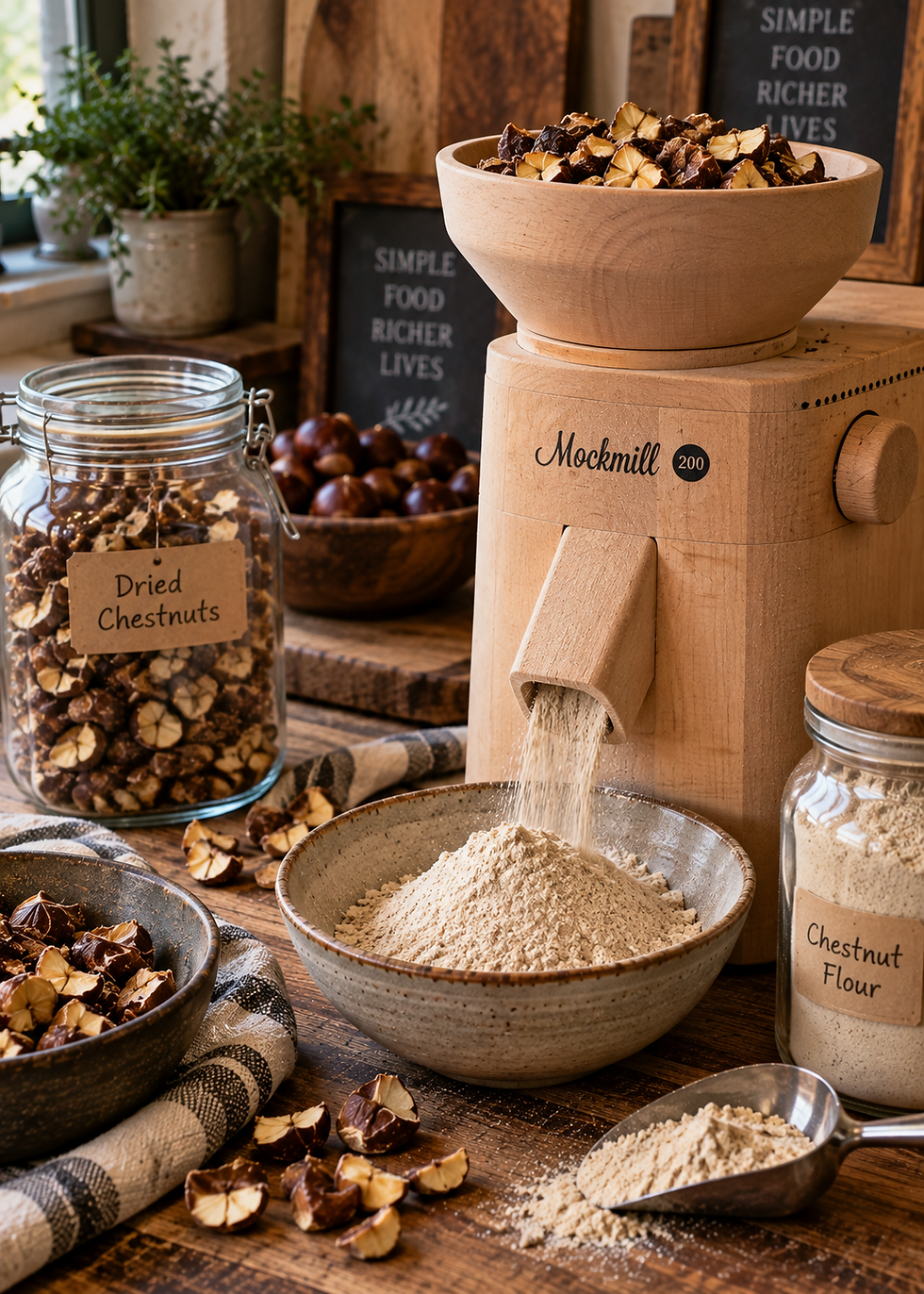
This may be my favorite reason to preserve chestnuts.
Once thoroughly dried, chestnuts can be milled into flour.
And suddenly the chestnut reveals an entirely different side of itself.
Chestnut flour is naturally gluten-free, softly sweet, and distinctly nutty. It can be incorporated into pancakes, quick breads, cakes, cookies, pasta, porridge, and other baked goods.
Because chestnut flour contains no gluten, it doesn't behave like wheat flour in yeast breads. Rather than automatically replacing all of the wheat flour in a familiar bread recipe, it is often better used as one component of a flour blend unless you are following a recipe specifically developed around chestnut flour.
Its sweetness also means it can bring flavor to a recipe without relying entirely on added sugar.
If you mill your own grains at home, making chestnut flour is particularly satisfying. Just make absolutely certain the chestnuts are completely dehydrated before putting them through a grain mill—and check your mill manufacturer's instructions to be certain dried chestnuts are approved for your particular machine.
A food processor or high-powered blender can also turn very dry chestnut pieces into a coarse meal or flour, although the texture may not be as fine as commercially milled chestnut flour. I use my coffee grinder that is used specifically for grinding herbs and spices.
A Modern Chestnut Pantry
You don't have to preserve an entire winter's food supply to borrow something useful from the old chestnut traditions.
Perhaps you roast one batch to eat immediately.
Another gets cooked and frozen.
Some becomes purée.
And a final tray goes into the dehydrator to become flour.
One bag of fresh chestnuts has suddenly become several different ingredients, each waiting for a different meal.
That is the kind of versatility I find so compelling about traditional pantry skills. Preservation doesn't merely make food last longer.
It gives us more ways to use it.
The chestnut harvest may only arrive once a year, but with a little preparation, it doesn't have to disappear when autumn does.
Bringing Chestnuts Back Into the Kitchen

Perhaps the biggest obstacle to cooking with chestnuts isn't peeling them.
It's knowing what to do with them afterward.
For many Americans, chestnuts occupy a very small culinary corner. We roast them at Christmas—or perhaps add them to stuffing—and then forget about them for another year.
But once you begin thinking of chestnuts as a starchy autumn ingredient rather than simply a nut, an entirely different pantry opens up.
Their flavor is mild enough to move easily between savory and sweet. They have an earthy nuttiness, but also a gentle natural sweetness that becomes more pronounced when roasted. Their soft texture allows them to absorb surrounding flavors while still contributing richness and substance of their own.
Chestnuts + Mushrooms

Few combinations feel more like the autumn woods.
The earthy, deeply savory character of mushrooms provides contrast to the subtle sweetness of chestnuts. Add thyme, sage, garlic, onions, or a splash of dry white wine and the combination becomes the foundation for soups, stuffings, grain dishes, pasta fillings, or hearty sauces.
A creamy chestnut and mushroom soup is one of the simplest ways to experience the pairing. Some chestnuts can be blended into the broth for body while others remain in pieces for texture.
Chestnuts and mushrooms are also wonderful with barley, farro, or wild rice, creating the kind of substantial meatless meal that doesn't feel as though anything is missing.
Chestnuts + Apples & Pears

Chestnuts belong naturally beside the orchard harvest.
Apples provide acidity and brightness against the chestnut's mellow sweetness, while pears bring a softer, more floral quality.
The combination doesn't have to be dessert.
Chestnuts and apples can be folded into savory stuffing, served alongside roasted poultry or pork, simmered into soup, or added to an autumn grain bowl with herbs and toasted seeds.
For something sweeter, chestnuts pair beautifully with cooked apples or pears, cinnamon, vanilla, maple, honey, and warm spices.
Chestnuts + Winter Squash

If chestnuts are the starch of the autumn forest, winter squash may be its garden counterpart.
Both become sweet, soft, and creamy when cooked, but their flavors are different enough to complement one another. Chestnuts bring nuttiness and depth while squash contributes color, moisture, and its own earthy sweetness.
Try adding chopped roasted chestnuts to stuffed delicata or acorn squash, blending them into butternut soup, incorporating chestnut flour into squash breads, or scattering chestnuts over roasted squash with rosemary or sage.
A little acidity—lemon, cider vinegar, or perhaps tart apple—can keep the combination from becoming overly sweet or heavy.
Chestnuts + Beans & Grains

This is where chestnuts begin to reveal their old role as everyday food.
Combine them with white beans, lentils, barley, rye, farro, oats, or rice and suddenly they aren't merely an accent. They become part of the substance of the meal.
Chestnuts can be simmered into a white bean and rosemary soup, folded through a mushroom-barley pilaf, added to savory porridge, or chopped into a grain bowl with roasted vegetables and herbs.
These combinations are especially useful if you are trying to build meals around plants without relying on highly processed substitutes. The chestnut contributes texture and carbohydrate while beans or lentils provide additional protein and fiber.
Chestnuts + Herbs

Chestnuts particularly love the herbs of the autumn kitchen.
Sage brings an earthy, slightly resinous character that works beautifully in stuffings and savory dishes.
Rosemary provides a stronger aromatic contrast, especially with roasted chestnuts, beans, poultry, or root vegetables.
Thyme is gentler and especially good with mushrooms, onions, soups, and grain dishes.
Marjoram is another lovely choice. Its softer, sweeter character can complement chestnuts without overwhelming their delicate flavor.
Parsley, bay, savory, and even a little nutmeg can also find a place depending upon the dish.
And Yes, Chestnuts Can Be Dessert

The natural sweetness of chestnuts makes them remarkably suited to desserts without requiring them to become overwhelmingly sweet.
Chestnut purée can become the foundation for cakes, creams, puddings, fillings, or spreads. Chestnut flour brings its own sweetness to pancakes, quick breads, muffins, and rustic cakes.
Chocolate is a classic partner, particularly darker chocolate whose bitterness balances the chestnut's sweetness. Vanilla, coffee, orange, pear, apple, maple, honey, and warm spices all work beautifully as well.
But chestnuts don't need much embellishment.
Sometimes a warm roasted chestnut eaten straight from its shell is enough.
Think Beyond the Recipe
The real goal isn't to memorize twenty things to make with chestnuts.
It is to understand the ingredient well enough that when a bowl of peeled chestnuts is sitting in front of you, ideas begin to appear.
Making soup? Blend in a handful.
Roasting vegetables? Add some chestnuts.
Cooking barley? Fold them through with mushrooms and herbs.
Making stuffing? Chestnuts belong there.
Baking bread? Experiment with a little chestnut flour.
Have apples that need using? Put the two together.
This is how ingredients become part of a kitchen rather than something purchased for a single recipe.
And perhaps that is one small way we can restore the chestnut to the place it once occupied.
Not by trying to recreate the past exactly, but by learning how to cook with it again.
From the Hearth to the Modern Kitchen
The recipes that follow draw inspiration from both traditional chestnut cookery and the foods of the autumn harvest—pairing chestnuts with mushrooms, apples, winter squash, grains, herbs, and other seasonal ingredients. Some look back toward the hearth, while others take chestnuts in a decidedly modern direction. Together, they offer a glimpse of just how much can come from one humble autumn harvest.
Chestnut Farms
Harrison's California Chestnuts - Who I have purchased from


Comments