

The Early American Autumn Hearth

There is something about autumn that makes me want to look backward.
Not toward the pumpkin-spice version of fall we have created today, with its artificial leaves and everything suddenly dressed in orange, but toward an autumn shaped by the harvest itself.
Imagine an early American kitchen as the season begins to turn. Baskets of apples have come in from the orchard. Winter squash and pumpkins are being gathered from the garden and fields. Corn and beans have reached maturity. Walnuts, chestnuts, and other nuts are being collected from the woods. Grain waits to be ground. Herbs are drying for the months ahead. Cider is being pressed, food is being stored and preserved, and the working hearth at the center of the kitchen transforms the season's abundance into meals.
For the people who lived here centuries ago, autumn was not simply something to celebrate. It was a season of preparation. What could be gathered, harvested, hunted, preserved, dried, fermented, stored, or put away would help determine what was available when the landscape became less generous in winter.

But the story of the early American autumn table did not begin with European settlement.
Long before Europeans arrived, Indigenous peoples across North America had developed sophisticated foodways adapted to their particular landscapes and seasons. Corn, beans, squash, wild plants, nuts, berries, game, fish, and other foods were cultivated, gathered, hunted, preserved, and prepared according to traditions that stretched back generations. European settlers brought their own crops, livestock, recipes, preservation methods, and culinary traditions, while African knowledge and foodways would also profoundly shape the developing American kitchen. What emerged was never one single "early American cuisine," but a complicated food story shaped by people, place, necessity, exchange, adaptation, and sometimes tremendous human suffering.
That is the story I want to begin exploring with The Early American Autumn Hearth.
This isn't an attempt to recreate the past or pretend that life centuries ago was somehow simpler or better. Nor will every dish in this series be presented as an authentic historical recipe. Sometimes we'll step directly into the historical kitchen and explore a documented dish or cooking method. Other times, I'll take the ingredients that belonged to a particular time and place and bring them into my own kitchen, creating something new while allowing those older flavors to provide the inspiration.
We'll wander through orchards and fields, forests and gardens. We'll explore apples and cider, corn and grains, winter squash, walnuts and chestnuts, wild game and turkey, herbs, broths, breads, preserves, and the foods that carried the harvest into winter. Along the way, we'll look at where these foods came from, who cultivated them, how they were used, and what they can still teach us in a modern kitchen.
Because perhaps there is something worth recovering from the autumn hearth—not the hardships of the past, but the knowledge held around it.
The knowledge of what the season provides. How to make good food from it. How to preserve abundance for another day. And how much more interesting autumn can taste when we allow the harvest, rather than a marketing campaign, to tell us what fall is supposed to be.
What Do We Mean by Early American Food?

There was no single early American cuisine.
The foods eaten here were shaped by many people and traditions. Indigenous peoples had cultivated, gathered, hunted, fished, cooked, and preserved foods across the Americas for thousands of years before Europeans arrived. European settlers brought their own ingredients, livestock, recipes, and cooking traditions across the Atlantic. African foodways and agricultural knowledge would also become deeply woven into the developing American food landscape.
All of these traditions are important parts of the larger story of American food.
For The Early American Autumn Hearth, however, I will be following primarily the European thread of that story. This is not because it was the only tradition present, but because it is the one most closely connected to my own heritage and the history I want to understand more deeply.
My ancestry reaches into several parts of Europe and stretches back through generations of early American families. That has made me increasingly curious about food as a way of exploring where I came from. What culinary traditions did people carry with them across the Atlantic? Which familiar foods could they continue to grow? What did they have to leave behind? What new ingredients did they encounter? And how did their cooking change as generations adapted to a very different landscape?
Even within the European experience, there was no single answer.
English, Scottish, Irish, German, French, Dutch, Scandinavian, and other settlers brought different food traditions with them. Geography mattered too. A household in New England lived within a different food landscape than one in Pennsylvania or Virginia. Climate, soil, proximity to the coast, access to markets, wealth, season, and simple availability all influenced what might appear on the table.
Settlers also encountered foods that were native to the Americas and had long histories of cultivation and use before Europeans arrived. Corn, beans, pumpkins, and other squashes gradually entered European-American kitchens, where they were incorporated into familiar cooking methods and adapted to new dishes. At the same time, settlers planted Old World grains, orchard fruits, vegetables, and herbs and raised the livestock they knew from Europe.
The resulting food was neither entirely Old World nor entirely new.
Recipes changed because ingredients changed. Traditions crossed an ocean and adapted to a new landscape. Foods unfamiliar to one generation could become ordinary to the next. Regional American cooking slowly began to take shape. That meeting point is what fascinates me.
Throughout The Early American Autumn Hearth, I'll explore the foods, cooking methods, and seasonal traditions of European settlers in early America while acknowledging the origins of the ingredients they encountered along the way. Sometimes we'll follow an ingredient back across the Atlantic. Other times, we'll discover that something we now think of as quintessentially American had a history on this continent long before Europeans ever arrived.
I may never know exactly what simmered in the pots or baked beside the hearths of my own ancestors. But by learning about the foods available in the places and periods in which they lived, I can begin to understand the world around their tables—and perhaps bring a small piece of that history into my own kitchen.
When Old World Traditions Met a New Land

Crossing the Atlantic meant bringing more than belongings. European settlers also carried memories of how food was supposed to taste, how bread was made, which herbs belonged in the cooking pot, how meat was preserved, what should be planted in a garden, and which foods marked the changing seasons.
Whenever possible, they brought those traditions with them.
European grains such as wheat, rye, barley, and oats were planted in American soil. Orchards were established with apples and pears. Gardens supplied familiar vegetables and culinary herbs. Cattle, pigs, sheep, and other domesticated animals provided meat, milk, and fat. Breadmaking, brewing, cheesemaking, preserving, and other familiar food skills continued in the new settlements.
But carrying a tradition across an ocean did not mean it remained unchanged.
Climate and growing conditions varied tremendously across the colonies. A crop that flourished in one region might struggle in another. Familiar ingredients could be difficult to obtain, expensive, or simply unavailable. Settlers had to learn what would grow reliably in their new surroundings and make use of foods the American landscape provided.
That landscape also introduced Europeans to ingredients that had no equivalent in the kitchens they had left behind.

Corn became one of the most important. Pumpkins and other squashes offered nutritious food that could be stored well into the colder months. Beans, cranberries, maple products, wild nuts, game, and other foods native to North America became increasingly familiar. Many of these foods had already been cultivated, gathered, and used by Indigenous peoples for generations before European settlement.
What interests me most is what happened next.
People did what cooks have always done: they adapted.
A familiar preparation might be made with an unfamiliar ingredient. A newly encountered crop could be cooked using an Old World technique. European herbs and seasonings found their way into dishes made from American plants and game. Foods once considered foreign gradually became ordinary parts of the household pantry.
Autumn would have made this meeting of food traditions particularly visible. The harvest could bring together apples from European orchard traditions with American pumpkins and squash; Old World grains with native corn; familiar culinary herbs with wild game from the surrounding landscape. Some foods were eaten immediately, while others were dried, ground, fermented, preserved, or stored to carry the household through winter.
The early American kitchen was therefore not frozen in the traditions of Europe. It was a kitchen in the process of becoming something different.
And perhaps that is one of the most interesting ways to explore it—not by asking only, What did people eat? but also:
What did they bring with them, what did they find when they arrived, and what did they create when those two worlds met?
The Early American Autumn Pantry
If we could step into an early American household during the autumn months, the pantry would tell us a great deal about the landscape outside.
This was the season when orchards, gardens, fields, and forests offered some of their greatest abundance. But abundance came with responsibility. Fresh food would not remain fresh indefinitely, and there was a long winter ahead. Some foods could be eaten immediately, while others needed to be dried, ground, preserved, fermented, or carefully stored.
The autumn pantry was therefore more than a collection of ingredients. It represented the work of turning a seasonal harvest into food that could nourish a household for months to come.

From the Orchard
Apples were among the great treasures of the autumn harvest.
The apples grown in early America were far more varied than the handful of familiar varieties that dominate modern supermarkets. Some were valued for eating, others for cooking, drying, or storing, and enormous quantities were destined for cider.
Pears and, in some households and regions, quince added to the orchard harvest. Fruit could be eaten fresh while it lasted, cooked into dishes, dried, preserved, or carefully stored for later use.
The orchard was not simply producing dessert. Its harvest supplied everyday food and drink.

From the Field and Garden
Autumn brought some of the most recognizable foods of the American harvest.
Pumpkins and other winter squashes could be kept for extended periods when properly harvested and stored. Corn could be allowed to mature and dry before being ground into meal. Dried beans provided another food that could wait patiently in the pantry until it was needed.
These crops were native to the Americas and had been cultivated long before Europeans arrived. For settlers accustomed to Old World grains and vegetables, learning to use them opened an entirely new pantry.
European garden crops continued alongside them. Cabbage, onions, turnips, carrots, parsnips, beets, and other vegetables helped fill the autumn kitchen and, depending upon the crop and conditions, could be stored or preserved for the colder months.

From the Grain Bin
Grain formed the foundation of countless meals.
Wheat might become bread, biscuits, dumplings, or pastry. Rye could thrive where wheat struggled and found its way into breads and porridges. Oats and barley provided hearty fare, while corn—once Europeans learned to depend upon it—became increasingly important in many colonial kitchens.
Grain did not arrive conveniently milled and packaged in a paper sack. It had to be harvested, threshed, cleaned, stored, and ground before it could become supper.
A sack or barrel of grain represented both nourishment and security.
From the Forest
Not every autumn harvest came from something deliberately planted.
Forests offered their own seasonal abundance.
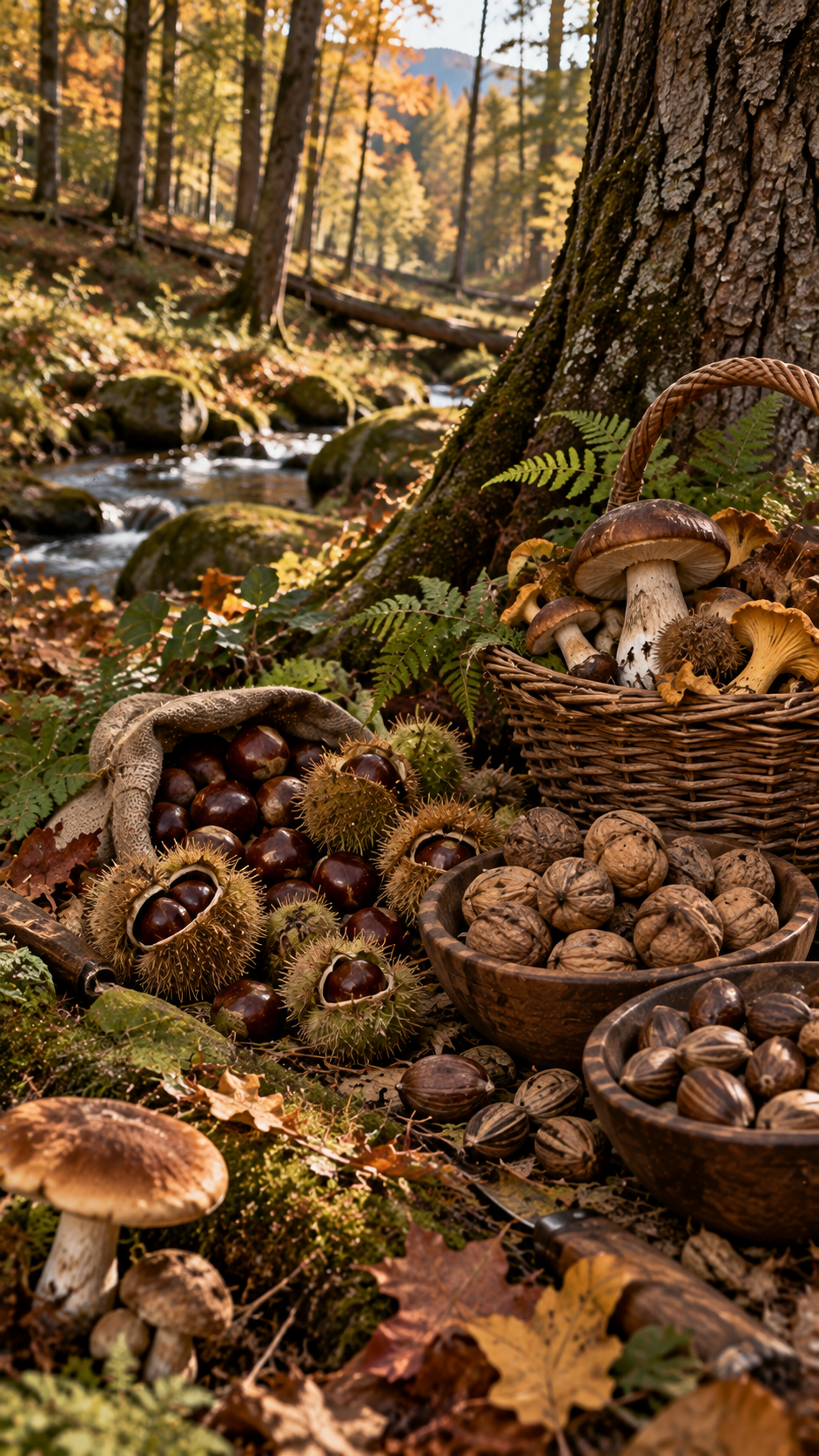
Walnuts, hickory nuts, chestnuts, and other locally available nuts could be gathered and stored. Of these, the American chestnut is especially fascinating. Before chestnut blight devastated the species centuries later, enormous chestnut trees were a familiar part of eastern forests, producing a crop that fed both people and wildlife.
Wild berries and other edible plants supplemented what came from gardens and orchards, while mushrooms appeared according to season and place.
The forest was pantry as much as wilderness.

From the Hunt
Autumn also brought food from the hunt.
Deer, wild turkey, and other game varied according to region and availability. For households that hunted, wild meat could supplement livestock and provide valuable food as the growing season came to an end.
Bringing an animal home was only the beginning. Meat had to be butchered and cooked, preserved, or otherwise used before it spoiled. In a world without refrigeration, knowing how to handle food was not an optional culinary hobby. It was part of feeding a household.

From the Herb Garden
Then there were the quieter ingredients—the ones capable of changing an entire pot of food.
European settlers cultivated familiar culinary and household herbs wherever circumstances allowed. Parsley, sage, thyme, marjoram, and other herbs helped carry familiar flavors into an unfamiliar landscape.
Some could be used fresh during the growing season and dried for later use, allowing a little of the garden to remain in the kitchen long after frost arrived.
These weren't merely decorative garnishes scattered over a finished plate. Herbs seasoned meats and vegetables, flavored soups and broths, accompanied preserved foods, and helped cooks turn simple staples into something worth gathering around the table to eat.
Taken together, these foods created an autumn palette far richer than the handful of flavors we now associate with the season: apples and cider, corn and grain, squash and roots, chestnuts and walnuts, game, herbs, and foods carefully stored for winter.
This was what autumn tasted like before autumn became a flavor of its own.
The Working Hearth: The Heart of the Early American Kitchen

Today, a glowing fire is something we tend to associate with comfort—a cold evening, a warm drink, perhaps a chair pulled close to the flames. In an early American kitchen, the hearth was certainly a source of warmth, but it was also something much more practical.
It was the cooking equipment.
The hearth did not suddenly come to life when autumn arrived. Fire was used for cooking throughout the year, whether the day outside was bitterly cold or uncomfortably hot. As the autumn harvest came in, what changed was not the presence of the fire but the foods and work surrounding it.
There were no temperature dials to turn or timers to set. A cook had to understand the fire itself.
A roaring flame was not always what was wanted. Different preparations required different kinds of heat, and much of hearth cooking depended upon managing glowing coals rather than cooking directly over tall flames. The cook tended the fire, moved coals, adjusted pots, judged heat by experience, and learned where different foods should be positioned in relation to it.
An iron pot suspended over the hearth could hold a soup, stew, porridge, or boiling water. Pots could be raised or lowered to change the intensity of the heat. Frying pans and skillets could be placed over coals. Meat might roast near the fire, where it required turning and attention as it cooked.

Baking presented its own challenges.
Before the modern kitchen oven, baking might be done in a separate brick or masonry oven or in covered cast-iron vessels surrounded by hot coals. Bread, pies, biscuits, and other baked foods depended upon a cook's ability to judge when the oven or coals were ready—not by reading a number on a display, but through knowledge gained by doing the work again and again.
Even seemingly simple foods demanded skill. A pot simmering too close to intense heat could scorch. Bread could burn before its center finished baking. Meat needed to cook thoroughly without drying out. And while one dish cooked, the fire still had to be maintained for everything else the household required.
Autumn added another layer of work.
The harvest brought apples to cook and preserve, grains and corn to prepare, squash to roast, broths and stews to simmer, and foods that needed to be processed for storage. The hearth became one part of a much larger seasonal rhythm of cooking and preservation.
This is one reason I find the early American kitchen so fascinating. Recipes alone tell only part of the story. Knowing how to prepare food without modern appliances was itself a form of knowledge.
Today I can place a pot on the stove, turn a knob, and expect almost exactly the same heat every time. I can set an oven to 375°F and walk away while it regulates itself. Those conveniences are easy to take for granted.
The cooks who worked around an early American hearth relied instead on observation, experience, and their senses. They watched the color of the coals, felt the heat, listened to what was happening in the pot, smelled when something began to brown, and adjusted as they went.
In many ways, the hearth demanded that the cook pay attention to the food.
We may not want to trade our ovens and stovetops for an open fire, but that kind of attentiveness is a kitchen skill still worth carrying forward.
Preparing the Harvest for Winter

A plentiful autumn harvest was only as useful as a household's ability to make it last.
Without refrigerators, freezers, or a grocery store waiting down the road, the weeks of abundance could not be taken for granted. As fruits ripened, grains matured, nuts fell, and gardens reached the end of their growing season, part of the work of autumn was deciding what could be eaten now and what needed to be prepared for the months ahead.
Fortunately, not everything required elaborate preservation.
Some foods came with their own remarkable keeping qualities. Winter squash could remain usable for months when properly cured and stored. Onions and certain root vegetables could be kept under suitable conditions. Carefully selected apples could be stored, while nuts, dried beans, grain, and corn could wait much longer for their turn in the kitchen.
Other foods required more intervention.

Apples and other fruits could be dried, cooked, or made into preserves. Cabbage and vegetables could be pickled or fermented. Herbs gathered from the garden could be dried and tucked away for later cooking. Corn and grains could be dried and stored until they were needed for grinding.
Meat presented an even greater challenge. An animal provided a tremendous amount of valuable food, but fresh meat was highly perishable. Salting, smoking, drying, and other preservation methods allowed at least part of that harvest to be kept rather than immediately consumed.
Preservation wasn't simply about creating special foods for the pantry. It was a practical way of extending the landscape's abundance beyond the season in which it appeared.
And it required knowledge.
Which apples would keep and which needed to be used quickly? Was a squash mature enough to store? Had grain dried sufficiently? Was the cellar cool enough? Had meat received enough salt? Would moisture ruin something that had been carefully put away?
The pantry was not something filled in a single afternoon. It was built gradually as different foods reached their moment in the season.
There is something about that idea that still feels useful today.
Our methods have changed dramatically. I don't need to salt a piece of meat simply because I want to eat it several months from now, and my freezer can accomplish in hours what earlier households achieved through considerably more work.
But the principle behind the autumn pantry hasn't become obsolete.
When apples are plentiful, we can make apple butter or freeze apples for baking. When winter squash is at its best, we can roast extra and freeze the purée for soup, pancakes, biscuits, or bread. Herbs can still be dried. Fruit can become small batches of refrigerator spread. Broth can be frozen in portions. Grains and beans can be stocked for the colder months ahead.
Preserving the harvest today doesn't have to mean recreating every method used centuries ago.
It can simply mean recognizing abundance when it appears and finding a practical way to carry some of it forward.
Perhaps that is one of the most useful lessons of the old autumn pantry:
Enjoy what the season gives us now, but remember to save something for later.
What Did Autumn Actually Taste Like?

Ask someone today what autumn tastes like and the answer will probably involve cinnamon, nutmeg, cloves, and pumpkin.
There is nothing wrong with any of those flavors—I enjoy warm spices as much as anyone—but somewhere along the way, our idea of autumn became remarkably narrow.
The autumn kitchen once had a much larger vocabulary.
It tasted of apples coming in from the orchard and fresh cider. It tasted of cornmeal and newly harvested grain, roasted squash and earthy root vegetables. There were walnuts cracked from their shells, chestnuts roasting near the fire, mushrooms gathered from the woods, and herbs brought in from the garden.
There were savory flavors too—something that can easily get lost in our modern obsession with sweet autumn foods.
Sage, thyme, marjoram, parsley, onions, and other herbs and aromatics accompanied meat, vegetables, broths, breads, and grains. Wild game brought its own deep flavors to the table. Apples and cider could move easily from sweet preparations into savory ones, while nuts added richness and texture to both.
And then there were the flavors created by cooking itself.
The browned edges of roasted squash. The crust of freshly baked bread. Grain toasted before becoming porridge. Meat slowly roasting beside the fire. Apples cooking until their juices concentrated. Nuts warmed until their oils became fragrant. A broth simmering long enough for a handful of simple ingredients to become something much greater than they were individually.
These are autumn flavors too.
Perhaps instead of thinking of autumn as a particular combination of spices, we can begin to think about relationships between ingredients.
Apple with sage or thyme.
Chestnut with mushroom.
Walnut with maple.
Cornmeal with squash.
Barley with mushrooms and herbs.
Cider with pork or turkey.
Pear with rosemary.
Venison with juniper.
Squash with brown butter and sage.
Rye with apple.
Cranberry with game.
None of these combinations needs an orange label or a spoonful of “pumpkin spice” to tell us what season we're in. The ingredients already do that.
And that may be what appeals to me most about returning to the autumn harvest for inspiration.
Fall doesn't need to be manufactured in the kitchen. It is already growing outside of it.
Bringing the Early American Hearth Into a Modern Kitchen
As fascinating as I find the early American kitchen, I have no desire to give up my refrigerator, freezer, oven, or running water.
The purpose of looking backward isn't to pretend that everything was better in the past. Cooking required tremendous labor, food could be uncertain, and many of the conveniences we barely notice today have made feeding ourselves safer and considerably easier.
What interests me is the knowledge behind the food.
Earlier cooks understood how to take what was available and turn it into meals. They knew which foods stored well, which needed to be preserved quickly, how to use inexpensive staples in many different ways, and how to work within the limitations of a season.
Those are skills that still belong in a modern kitchen.
So throughout The Early American Autumn Hearth, we won't be trying to recreate an early American household exactly. Instead, we'll use the past as a place to learn from and as inspiration for what we cook today.
Sometimes that will mean going directly to historical sources.
From the Historical Kitchen
When I find a documented recipe or preparation that is particularly interesting, we'll explore it together. We can look at what the original instructions tell us about the ingredients and cooking methods of the time and, when necessary, adapt them so they can reasonably be prepared in a modern kitchen.
The goal will be to preserve the character of the dish while acknowledging that most of us aren't regulating the temperature of a brick oven with a pile of glowing coals.
Other recipes will take a different approach.
Inspired by the Harvest
Not every recipe needs to have been written in a cookbook three hundred years ago to have a connection to the past.
Sometimes I may begin with ingredients that would have belonged to the food landscape we are exploring and simply ask: What would I make with these in my kitchen today?
Apples, chestnuts, and thyme might become a creamy autumn soup. Winter squash and cornmeal might become griddle cakes. Cider and sage might flavor braised turkey thighs. Mushrooms and barley might become a hearty supper.
These dishes won't be presented as historical recipes if they aren't. They are modern food inspired by older ingredients, seasonal traditions, and the landscapes from which they came.
That freedom is important to me because I don't want this series to become a museum of foods we admire but rarely cook.
I want these ingredients back in the kitchen.
I want to experiment with chestnut flour, cook more with rye and barley, discover unfamiliar varieties of winter squash, use apples in savory dishes, make broth from scratch, and find out what happens when older flavor combinations meet the way we actually cook now.
Perhaps most importantly, I want to recover some of the confidence that comes from understanding ingredients rather than simply following instructions.
A recipe can tell us what to make tonight. Knowing what to do with a basket of apples, a winter squash, a pot of beans, or a bag of grain gives us something much more lasting.
That is the piece of the old hearth I most want to bring forward:
not the equipment, but the knowledge.
Throughout the coming weeks, we'll follow the autumn harvest into the kitchen. So pull up a chair, bring your curiosity, and join me as we step up to The Early American Autumn Hearth.
There is a whole harvest waiting for us.
Next is Beyond Pumpkin: The Versatile Pantry Guide to Winter Squash


Comments